Choosing a Replacement Gate Operator: What Matters
How to Choose a Replacement Gate Operator (What Actually Matters)
- October 13, 2026
- Posted By David Dobrenic
The technician said replace, not repair. Now what?
The technician finished the diagnosis and gave you the news: the operator itself is done. Not a blown fuse, not a misaligned photo eye, but the operator has reached the point where repair no longer makes sense. If you haven’t already worked through that decision, our repair or replace your gate operator guide walks through how to tell the two apart. If you have, and replacement is where you landed, the question that comes next gets a lot less attention: what do you actually replace it with?
It is a fair question, because “gate operator” is not one product. It is a category that spans small residential swing arms rated for a handful of cycles a day up to industrial slide operators built to run continuously at a guarded commercial entrance. Buying the wrong class of operator, even from a reputable manufacturer, can lead to a brand-new installation struggling again sooner than expected.
Why “just get a new one” isn’t the whole answer
It is tempting to treat a gate operator replacement like swapping a garage door remote: pick something in the right price range, bolt it on, and move on. The operator is the part of the system that does the actual work of opening and closing the gate on command, and it is engineered around specific assumptions: how much the gate weighs, how far it travels, how many times a day it is expected to cycle, and what kind of safety devices it needs to work with.
When one of those assumptions is off, the operator does not usually fail immediately. It fails gradually, the same way an engine wears out faster when it is run harder than it was designed for. A homeowner who replaces a tired residential operator with another unit that is undersized for the gate’s actual weight may see smooth operation for a while before symptoms return, things like a gate that stops short, strains audibly, or starts tripping its own reset function. If any of that sounds familiar from before the replacement, it is worth reviewing common gate operator issues to see whether the pattern points back to a sizing problem rather than a new mechanical fault.
Start with what’s already there: swing or slide
Before anything else, a replacement operator has to match the mechanism already installed at the gate. A swing gate opens on hinges, with the operator arm pushing and pulling the gate panel through its arc. A slide gate runs along a track, with the operator driving the gate horizontally using a chain, belt, or gear rack. These are not interchangeable systems. A slide operator cannot be adapted to a swing gate and vice versa, so this part of the decision is usually already made for you by whatever gate is currently in the ground.
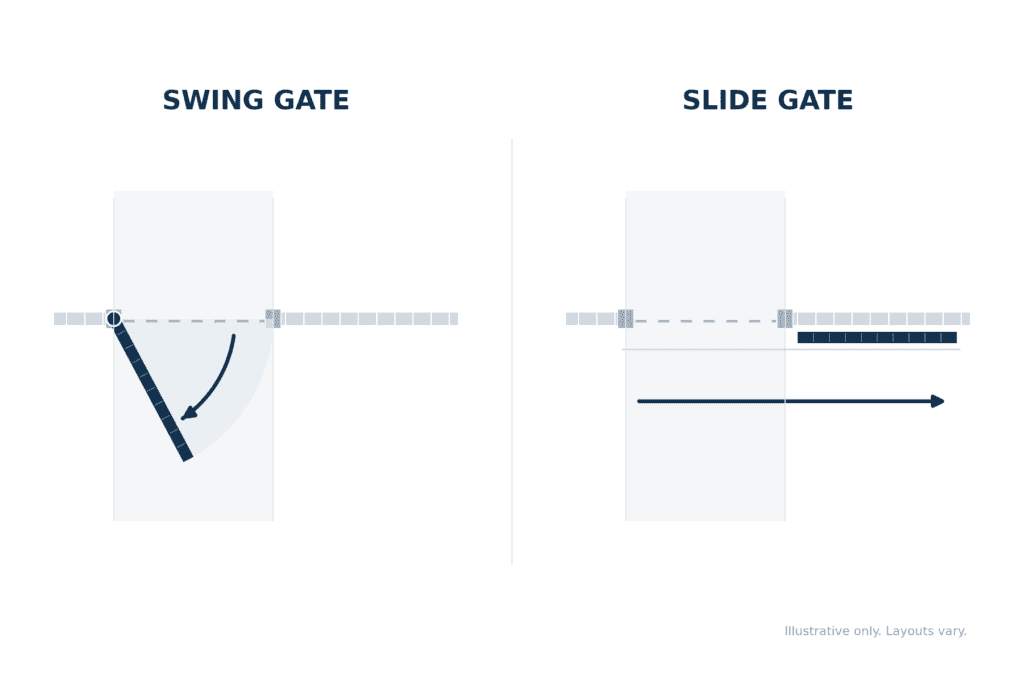
Within each category there is still a range. A residential slide operator, for example, is typically built around a lighter-duty DC motor and a gear-driven transmission sized for a single-family driveway gate. A residential swing operator in the same tier usually pairs a cast aluminum housing with a DC motor and features like soft start and stop, mid-travel reversal, and a manual disconnect for use during a power interruption. Confirming which tier your current gate falls into, based on its actual weight and length rather than a guess, is the starting point for everything that follows.
What is duty cycle, and why does it decide so much
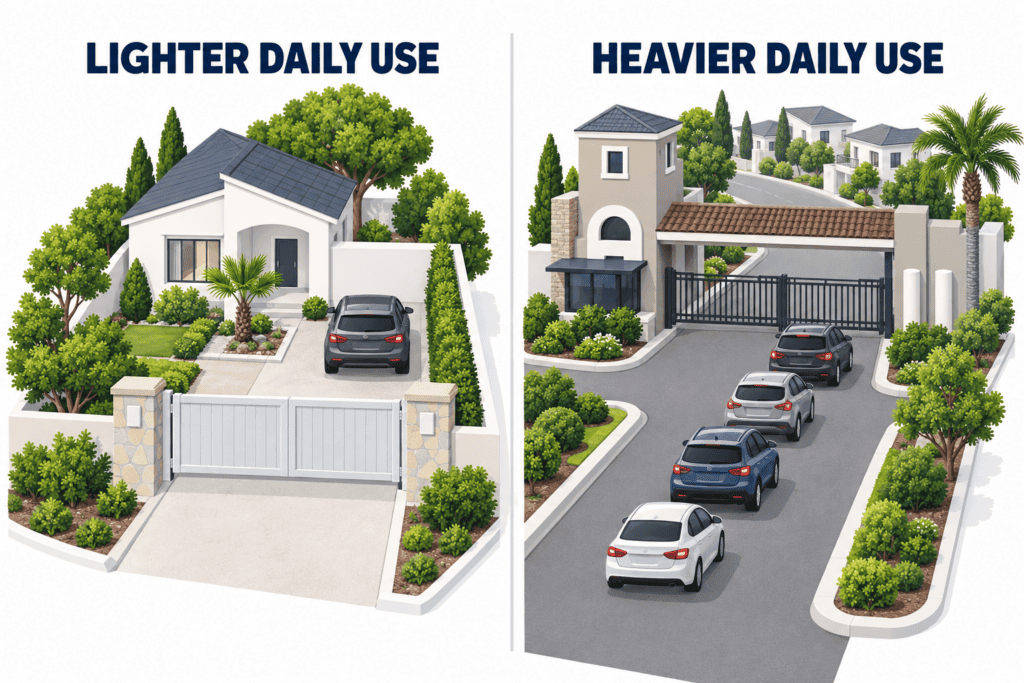
Duty cycle describes how much daily use an operator is built to handle without accelerated wear. It is not just a number on a spec sheet. It is the difference between an operator built to open and close a dozen times a day at a private residence and one built to run all day at an entrance that sees continuous vehicle traffic.
Gate operators are also built to different duty ratings tied to how the gate area is actually used, from lighter-duty residential applications up through heavier-duty settings like guarded or high-traffic commercial entrances. The exact rating isn’t something a homeowner needs to memorize, but the underlying idea matters: a duty rating is tied to how the gate area is actually used and who is expected to pass through it, not just how big or expensive the unit is. A commercial-grade operator installed on a rarely used residential gate is not “extra safe” by default, and a residential-grade operator installed at a busy shared entrance can wear out well ahead of schedule. Matching duty rating to actual use, not just to budget, is what helps avoid unnecessary strain and premature wear.
AC or DC: does the power type matter
Gate operators are generally built around either an AC motor wired directly to line power, or a DC motor that draws from a battery. Many modern DC gate operators use battery-based power systems that can provide continued operation during a power interruption, depending on the model and configuration, since the battery is charged through normal operation rather than added on as a separate accessory. An AC-only operator generally needs a separate backup accessory to gain that same capability.
LiftMaster’s own buyer’s guidance notes that many gate operators are built to run on battery power charged either by standard electrical service or, in locations where running power is impractical, by a solar panel. That flexibility is one reason DC operators have become common in both residential and commercial installations, even at properties with straightforward access to line power, since a charged battery can provide a margin of continued operation during an outage, depending on the setup.
Is a solar-powered operator worth considering
Solar-compatible operators pair a DC motor with a small solar panel that keeps the battery charged instead of, or in addition to, a wired electrical connection. This matters most at gates located far from the nearest power source, where trenching and running conduit would add real cost and disruption to the property.
It is not automatically the right call for every gate. A solar setup depends on the panel getting enough consistent sun exposure to keep the battery charged through the cycle demands placed on it, and a gate that is heavily shaded or that cycles far more often than expected can outpace what the panel and battery are sized to support. For a gate that already has reliable electrical service nearby, a standard AC or battery-backed DC operator is usually the more straightforward choice, with solar reserved for locations where running power genuinely is not practical.
Residential duty vs. Commercial duty: how do you tell which you need
The clearest way to separate residential from commercial duty is traffic, not property type. A single-family home with one or two vehicles cycling the gate a handful of times a day sits firmly in residential territory. A shared community entrance, an HOA gate serving dozens of households, or a business entrance with regular delivery and visitor traffic puts real daily cycle counts on the operator, and that calls for equipment built for it.
Commercial-duty slide operators, for instance, are often available in more than one horsepower rating specifically because gate weight and traffic volume vary so much between properties, with a lower-horsepower version suited to lighter gates and a higher-horsepower version built for heavier gates seeing more frequent use. If you’re replacing an operator at a shared or higher-traffic entrance rather than a single residential driveway, the sizing math is different from a typical residential job, and that difference is worth confirming with a technician before settling on a replacement.
Control boards and safety devices: what has to match
Replacing an operator is not just swapping the motor. The control board tells the operator where to stop, how fast to move, and how to respond when something interrupts the gate’s path. Safety devices, including photo eyes and edge sensors, connect into that control board to stop or reverse the gate if an obstruction is detected. Under UL 325, vehicular gate operators must use the required independent entrapment-protection means for each identified entrapment zone. The exact sensor setup depends on the operator, gate configuration, and manufacturer instructions, and that requirement applies to a replacement job the same way it applies to a brand-new install.
Some existing sensors and access hardware can carry over to a new operator, and some cannot, depending on wiring type and control board compatibility. Depending on the model, a replacement operator may include features such as inherent obstruction sensing, battery backup, or emergency-access functionality. None of this is something to guess at from a spec sheet. It is exactly the kind of detail a technician confirms in person before finalizing which replacement operator goes in.
Choosing a replacement operator in Plano and North Texas
North Texas heat, storms, power interruptions, and occasional winter weather can create demanding conditions for outdoor gate equipment. That matters when choosing a replacement operator, not just for the motor itself but for the control box that houses its electronics.
Outdoor-rated enclosures are built to a graded standard. A weather-resistant enclosure rating covers protection against rain, sleet, and snow, along with resistance to ice formation on the enclosure itself, which is directly relevant to an occasional Plano ice storm rather than a theoretical spec. Confirming that a replacement operator’s control box is rated for outdoor exposure, and that it is mounted and sealed correctly during installation, is a detail worth asking a technician about rather than assuming it’s already covered.
Working with a technician on the final decision
Everything above narrows the field, but the final match, confirming exact gate weight, current cycle count, existing wiring, and control board compatibility, is something a technician confirms on-site rather than from a spec sheet. A technician who can see the actual gate, track or hinge condition, and current wiring is in a much better position to confirm the right operator than a general online comparison can be.
Ready to talk through a replacement?
If a technician has already confirmed it’s time to replace your gate operator, matching the right model to your specific gate is where a site visit makes the biggest difference. Call 469-277-8333 to schedule gate operator service, or reach out through A1 Gate Guys’ contact page to get started.
FAQ
How long does a gate operator usually last before it needs replacing?
There is no fixed lifespan. How long an operator lasts depends heavily on how its duty rating compares to actual daily use, along with weather exposure and how consistently it has been maintained. An operator running far more cycles than it was rated for generally wears out sooner than one correctly matched to its workload.
Can a commercial-duty operator be installed on a residential driveway gate?
Generally, yes, mechanically speaking, but it is usually more equipment than a typical residential gate needs. Commercial-duty operators are built for higher daily cycle counts, so on a lightly used residential driveway the extra capacity mostly goes unused.
Does a replacement operator have to be the same brand as the old one?
Not necessarily, but wiring type, control board compatibility, and mounting hardware all need to line up. A technician can confirm what can carry over from the old installation and what needs to be replaced along with the operator.
What is the real advantage of a DC operator over an AC operator?
Many DC operators run off a battery that is kept charged, which can allow continued operation for a period after a power outage, depending on the model and setup. An AC-only operator generally needs a separate backup accessory for the same capability.
Do I need a solar-powered operator if my gate already has electrical service?
Usually not. Solar-compatible operators are most useful when running power to the gate location would be impractical or costly. If reliable electrical service is already in place, a standard AC or battery-backed DC operator is typically the more straightforward option.
Will my existing keypad, remote, or sensors work with a new operator?
Sometimes, but it depends on the wiring and whether the new control board supports the existing hardware. This is one of the details worth confirming during a technician’s on-site evaluation before the replacement is finalized.
How is a swing gate operator different from a slide gate operator when it comes to replacement?
They are not interchangeable. A swing operator mounts to the gate post and arm to push and pull the gate through its arc, while a slide operator drives the gate along a track. A replacement operator has to match whichever mechanism is already installed.
What role does gate weight play in choosing a replacement operator?
Operators are rated for a maximum gate weight and length. Exceeding that rating puts extra strain on the motor and transmission even if the power type and general category are otherwise correct, which can shorten the life of the new operator.
Is a more powerful operator always the safer choice?
Not automatically. Matching the operator’s duty rating and force settings to the actual gate and its safety devices is what keeps the system operating safely. An oversized operator that is not configured correctly can still create the same kind of entrapment risk as an undersized one.
Does the UL 325 safety standard apply differently to a replacement than to a brand-new gate installation?
No. The same UL 325 entrapment-protection requirements apply whether an operator is being installed for the first time or replaced, though the specific sensor setup depends on the gate and operator. A replacement is not exempt from current safety requirements simply because a gate was already in place.